Connections Hint Forbes: Daily Hints, Clues & NYT Puzzle Guide
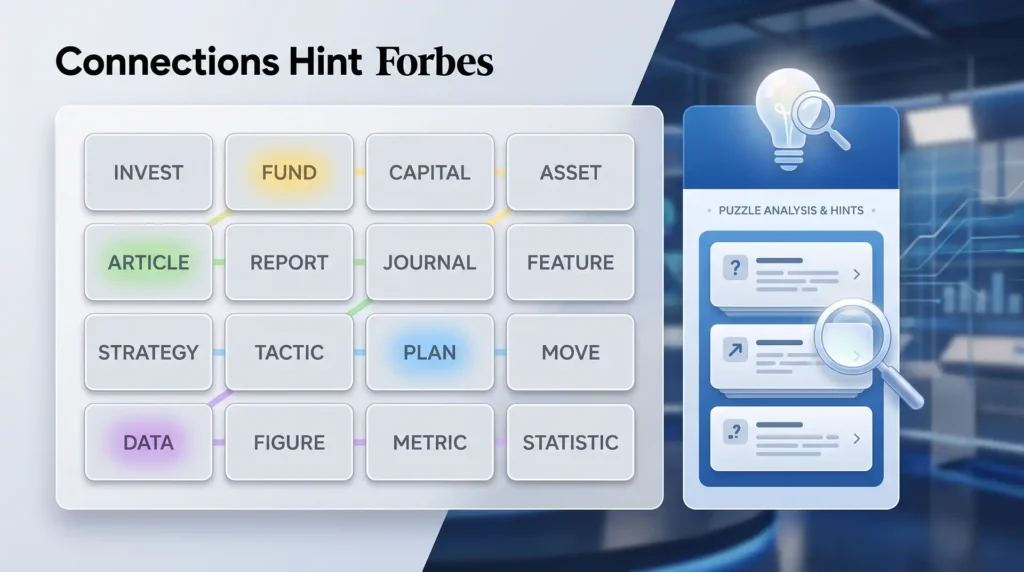
What Does “Connections Hint Forbes” Actually Mean? If you’ve typed connections hint forbes into Google recently, you’re in good company. Every single day, thousands of puzzle fans search that exact phrase hoping for a little nudge before diving into the latest NYT Connections puzzle. Here’s what it actually refers to: Forbes runs a daily article covering the New York Times Connections puzzle, packed with hints, category clues, breakdowns, and eventually the full answer set. The whole point is to help players work through tricky word groupings without just handing over every answer upfront. You’ll see people search this in a bunch of slightly different ways — connections hint today forbes, connection hints today forbes, connections hints forbes, connections nyt forbes — but they’re all after the same thing: just enough of a push to keep solving on their own. What makes Forbes’ coverage stand out from a plain answer dump is the staged approach. You control how much help you actually want, which keeps the puzzle-solving part of the experience intact. A Quick Refresher: What Is NYT Connections? Connections is the New York Times’ daily word-grouping puzzle. You’re handed sixteen words and have to sort them into four groups of four, where each group shares some kind of hidden logic. It’s a different animal from Wordle (guess one word) or a traditional crossword (clue-based). Connections is really testing your ability to spot patterns and catch multiple meanings hiding in plain sight. How a Round Actually Plays Out Each day you get: 16 words on the board 4 categories to uncover 4 words per category 4 mistakes allowed before you lose Get a category right, and those four words clear off the board — making what’s left a bit easier to work with. Ironically, though, the last remaining group is usually the hardest one to crack. The Basic Objective It’s simple in theory: Spot four words that belong together. Submit that group. Keep going until the board is empty. The difficulty comes from how many words look like they could fit into more than one group. When Does a New Puzzle Drop? A fresh Connections puzzle goes live every day at midnight, based on your local time zone — which is a big part of why so many people make it part of their morning routine. Quick Rules Reference Rule Details Total Words 16 Categories 4 Words Per Category 4 Mistakes Allowed 4 New Puzzle Daily How Forbes Approaches Its Daily Connections Coverage A big reason connections nyt forbes shows up so often in search is how well-organized Forbes’ daily write-ups are. Instead of dumping the full solution right away, each article ramps up the help gradually. The Structure of a Typical Hint Article Most guides open with something broad — just enough to point you in a direction without spelling anything out. Something like: “Think along the lines of musical instruments.” “A few of these relate to famous landmarks.” “Look for terms tied to cooking.” These nudges are meant to get your brain working, not just hand you an answer to memorize. The Hint Levels, Broken Down Level What’s Revealed Level 1 General direction/advice Level 2 Hints tied to specific categories Level 3 The actual category names Level 4 Full answers Level 5 Explanation of the logic behind each group This layered format means you decide exactly how much help you want before stopping. Category Name Reveals If the early hints don’t quite click, Forbes will often reveal just the category titles before listing out the actual words — which still leaves some of the challenge intact. Full Answers, When You Need Them Eventually, if you’re truly stuck, you can see: Every category name The complete four-word groupings How everything was meant to be arranged The difficulty color for each group The Explanation Section Is the Real Value Arguably the most useful part of any Forbes write-up is the “why” — explaining the logic connecting each group of words. That’s what actually helps you improve, rather than just copying the answer and moving on. As the saying goes, a good hint teaches you how to think, not just what to pick. Why “Connections Hint Today Forbes” Keeps Trending Search volume for phrases like connections hint today forbes keeps climbing, and it’s not hard to see why — people want a little help without fully spoiling the fun. Common triggers include: Getting stuck on a brutal purple category Words with confusing double meanings Multiple groups that look nearly identical at first glance Wanting to double-check a final answer Picking up new solving techniques along the way A lot of regular players deliberately hold off on full spoilers until they’ve genuinely run out of ideas. Breaking Down the Four Difficulty Colors Each category is color-coded, and the colors map directly to how tricky that group is. Yellow — The Starting Point Yellow groups tend to be the most obvious. Think along the lines of: Colors Fruits Months Animals These are usually the first ones players lock in. Green — A Step Up Green requires a bit more thought. Expect things like: Cooking ingredients Sports gear School subjects Clothing items Blue — Where Things Get Trickier Blue categories usually lean on broader knowledge: Pop culture Geography Historical references More technical vocabulary Purple — The Wildcard Category Purple is the one everyone talks about. It’s less about knowledge and more about creative thinking: Puns Rhyming word pairs Hidden prefixes Suffix-based patterns Words with double meanings General wordplay Category Types You’ll See Again and Again No two puzzles are identical, but certain patterns show up constantly. Synonyms — several words that essentially mean the same thing, like tiny, small, little, and miniature. Pop culture — movies, TV, music, celebrities, video games. Idioms and phrases — you need to recognize the expression, not just the dictionary definition. Words with multiple meanings — think of a word like “bark,” “spring,” “match,” or “seal,” each of which could plausibly belong to more than one group. Prefix/suffix patterns