
If you’ve spent any time reading about growing a website or an online shop, you’ve probably run into the term “SEO marketing” more times than you can count. And if you’ve ever stopped to wonder what is SEO marketing exactly, you’re definitely not the only one — it’s one of those phrases people throw around constantly, but rarely explain in plain terms.
So let’s break it down properly, without the jargon overload, and cover everything from what the term actually means to how it works in practice, what a real strategy looks like, and even how it applies somewhere like Etsy.
What Is SEO Marketing, in Plain Terms?
At its core, SEO marketing is the practice of shaping your website or online content so that it shows up higher in search engine results — think Google, Bing, or even the internal search bar on a marketplace like Etsy — when people search for things related to your business.
The goal is simple: when someone types a question or a product name into a search bar, you want your page to be one of the first things they see. More visibility in search results generally means more visitors, and more visitors usually means more potential customers.
It’s called “SEO marketing” specifically because it sits at the intersection of two things — search engine optimization (the technical and content-based work of ranking well) and marketing (the broader goal of attracting and converting an audience). One without the other doesn’t really work. You can optimize a page perfectly and still fail if nobody wants what you’re offering, and you can have a great product that nobody finds because the page behind it was never built to be discoverable.
What Does SEO Marketing Stand For?
If you’re wondering what SEO marketing stands for on a purely literal level, SEO is short for Search Engine Optimization. Add “marketing” onto the end, and you get the practice of using that optimization work as part of a bigger strategy to bring in traffic, leads, and sales.
Some people use “SEO” and “SEO marketing” interchangeably, and honestly, in casual conversation, that’s fine. But technically, SEO refers more to the mechanics — keywords, page structure, backlinks, site speed — while SEO marketing looks at the bigger picture: how that optimization work fits into your overall goals as a business or creator.
What Is SEO Marketing Meaning, Really?
Let’s dig a little deeper into the meaning behind it. Search engines like Google don’t just randomly decide which pages to show first. They use complex systems — commonly called algorithms — that scan and evaluate billions of pages, then rank them based on things like relevance, quality, trustworthiness, and user experience.
SEO marketing means working with that system instead of against it. It means writing content that actually answers what people are searching for, structuring your site so it’s easy for both humans and search engines to understand, and building enough credibility (through things like backlinks and consistent publishing) that search engines trust your site enough to rank it well.
In short: it’s not about tricking Google. It’s about genuinely being the best, most relevant answer to someone’s search — and then making sure Google (or whichever platform you’re targeting) can clearly see that you are.
What Is Search Engine Optimization Marketing and How Does It Work?
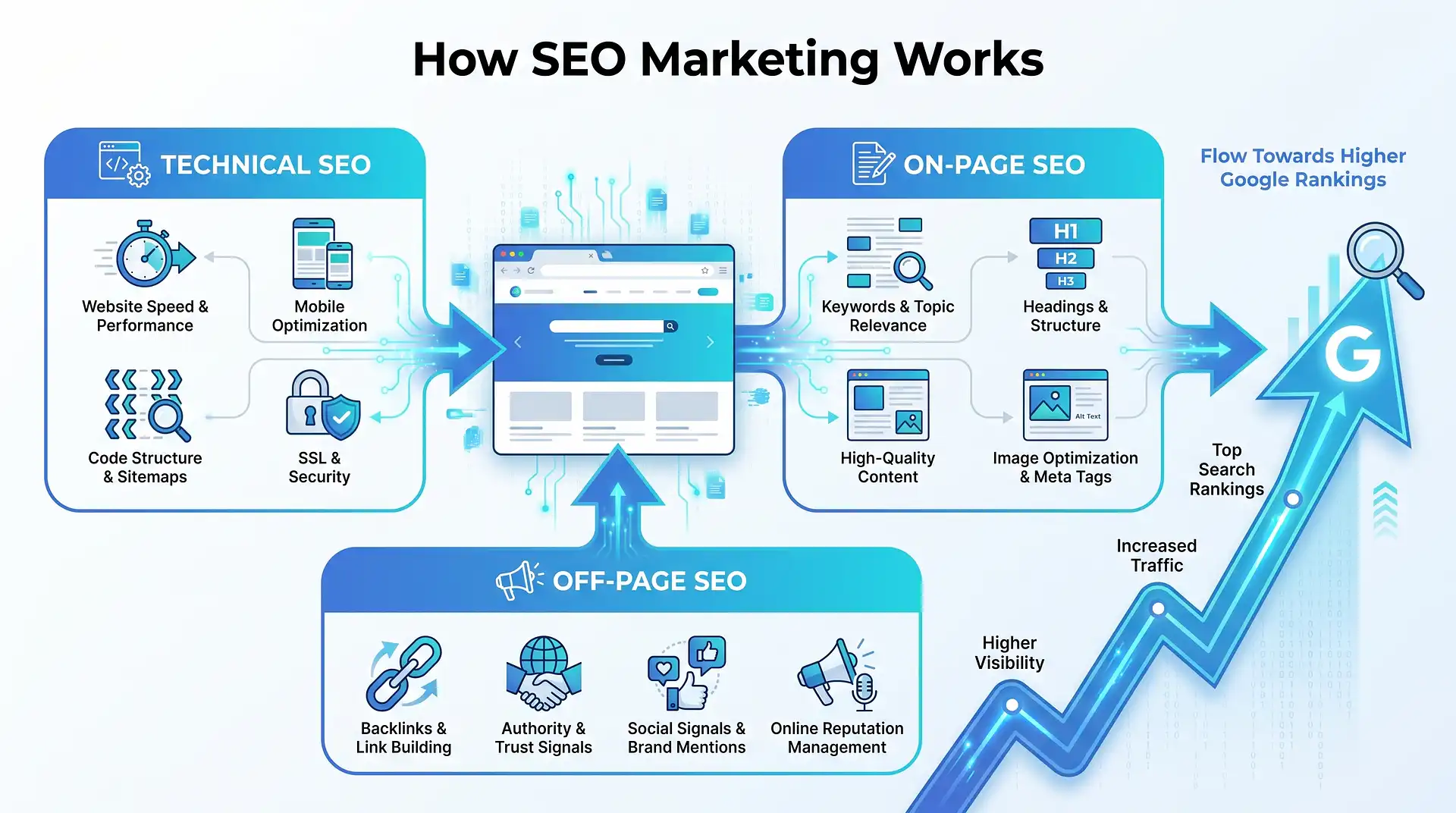
So how does the whole process actually work behind the scenes? It generally comes down to three interconnected pieces.
1. Technical SEO
This is the behind-the-scenes plumbing of your website. It covers things like how fast your pages load, whether your site works properly on mobile devices, how well search engines can “crawl” and index your pages, and whether your site structure makes sense. If this part is broken, none of your content — no matter how good — will perform well, because search engines simply won’t be able to read or trust it properly.
2. On-Page SEO
This is where your actual content lives. It includes things like your page titles, headings, the words you use throughout your content, image descriptions, and internal links to other pages on your site. On-page SEO is where the focus keyword strategy really comes into play — making sure your content naturally reflects the language your audience is actually searching for.
3. Off-Page SEO
This covers everything happening outside your own website that still affects your ranking — most notably backlinks, which are links from other websites pointing back to yours. Search engines treat these almost like votes of confidence. The more relevant, trustworthy sites that link to you, the more search engines tend to trust your content too.
When these three pieces work together, that’s when SEO marketing actually starts paying off — not overnight, but steadily, over weeks and months.
What Is SEO Marketing Strategy? Building a Real Plan
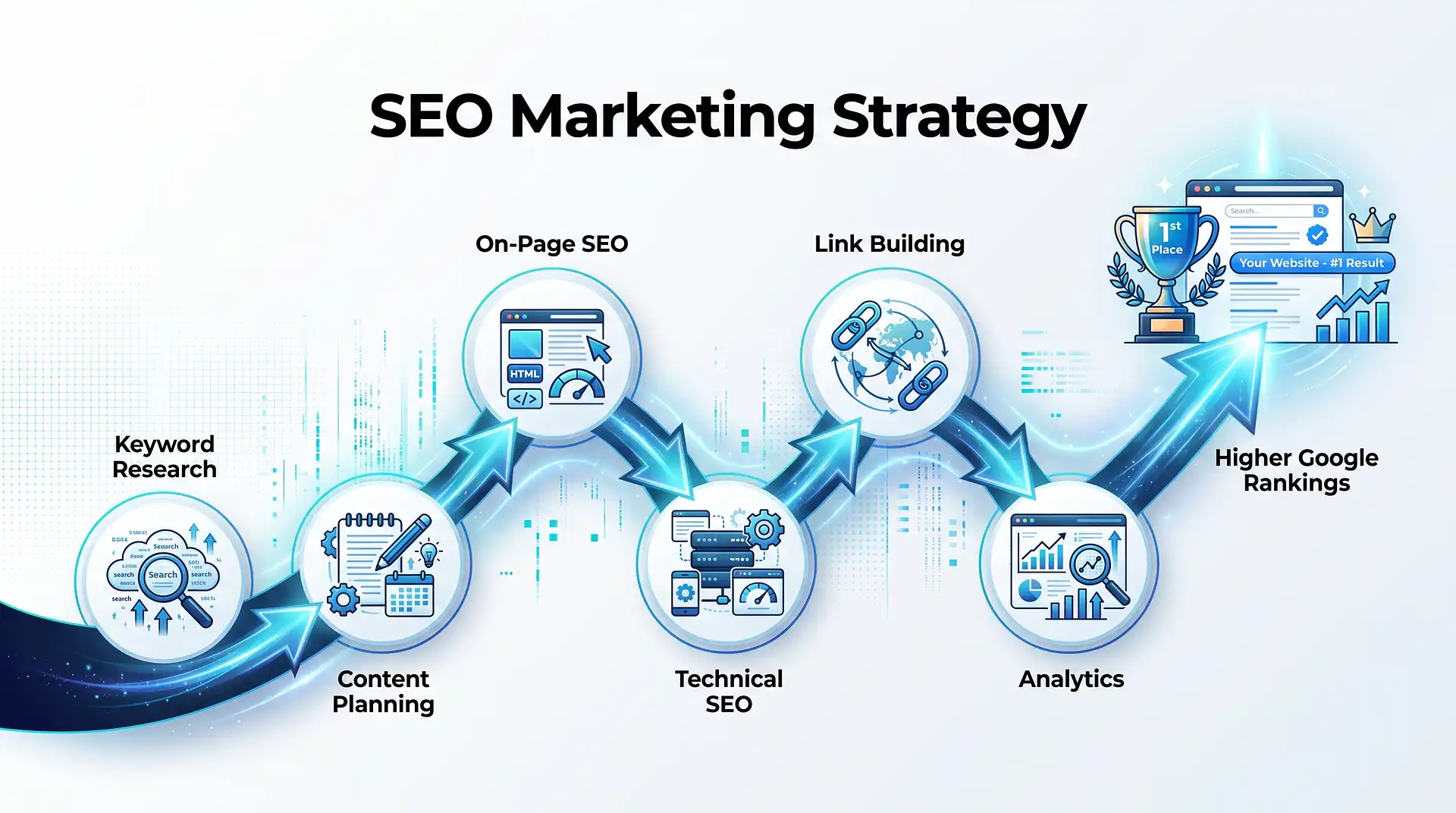
A strategy is where things move from theory into action. A solid SEO marketing strategy usually involves a handful of ongoing steps:
- Keyword research — figuring out exactly what your audience is typing into search engines, and how competitive those terms are.
- Content planning — building pages, blog posts, or product listings around those keywords in a way that actually helps the reader, not just stuffs in the right words.
- On-page optimization — refining titles, headers, meta descriptions, and internal linking so search engines clearly understand what each page is about.
- Technical health checks — making sure your site loads quickly, works well on phones, and doesn’t have broken links or duplicate content issues.
- Link building — earning backlinks from other credible sites, which helps build authority over time.
- Tracking and adjusting — regularly checking what’s working (and what isn’t) using analytics tools, then refining your approach based on real data.
A good strategy isn’t a one-time project. Search engines change their algorithms constantly, competitors publish new content, and audience behavior shifts — so SEO marketing works best as an ongoing habit rather than something you set up once and forget about.
What Is SEO Marketing Examples? Seeing It in Action
Sometimes the concept clicks faster with real-world examples. Here’s how SEO marketing plays out across different types of businesses:
- A local bakery optimizes its Google Business profile and website so it shows up when someone nearby searches “best bakery near me.”
- A software company publishes detailed how-to guides around problems their product solves, so people searching those exact problems land on their blog first.
- An online clothing store writes detailed, keyword-rich product descriptions instead of generic one-liners, helping products surface in relevant searches.
- A freelance photographer builds a portfolio site with location-based keywords, like “wedding photographer in Austin,” to capture local search traffic.
- A recipe blog structures content with clear headings, ingredient lists, and step-by-step instructions, which search engines favor for featured snippets.
In every case, the underlying idea is the same: understand what your audience is searching for, then build content or a storefront that genuinely satisfies that search better than the competition does.
What Is SEO Marketing Channel? Where This All Happens
The term “channel” here refers to the platforms and pathways through which SEO marketing efforts actually reach an audience. A few of the most common ones include:
- Organic search — the classic Google or Bing search results, where SEO marketing has the most direct impact.
- Content marketing — blogs, guides, and resource pages designed specifically to rank and attract search traffic.
- Local search — optimizing for location-based searches, especially important for brick-and-mortar businesses.
- Marketplace search — internal search engines on platforms like Etsy, Amazon, or eBay, where sellers optimize listings the same way websites optimize pages.
- Video search — optimizing content on platforms like YouTube, which functions as its own massive search engine.
Each of these channels has its own quirks, but they all rely on the same underlying principle: matching your content to what people are actually searching for, in the language they actually use.
What Is SEO Marketing Agency, and Do You Actually Need One?
An SEO marketing agency is essentially a team of specialists you hire to handle some or all of this work for you — keyword research, content creation, technical fixes, link building, and ongoing strategy adjustments.
Whether you need one really depends on your time, budget, and how competitive your industry is. A small local business with a straightforward website might be able to handle basic SEO marketing on their own with some research and consistency. A larger company competing in a crowded, high-stakes market, though, often benefits from bringing in a dedicated agency or in-house specialist, simply because the technical and competitive landscape gets complicated fast.
If you do decide to hire one, it’s worth asking how they measure success, what kind of reporting they provide, and whether their strategies focus on long-term, sustainable growth rather than quick shortcuts that could backfire later.
What Is SEO Marketing on Etsy? A Slightly Different Beast
Here’s where things get a little more specific. If you sell on Etsy, you’re not just dealing with Google’s search engine — you’re also dealing with Etsy’s own internal search system, and the two don’t work identically.
Etsy’s algorithm looks at things like the keywords in your listing titles, tags, and descriptions, but it also weighs how well your listings actually perform — clicks, favorites, and completed sales all factor in. On top of that, the overall health of your shop (things like response time, reviews, and consistency) plays into how visible your listings become over time.
Beyond ranking within Etsy itself, there’s also a separate layer: Etsy actively works to get its own marketplace pages ranked on Google too, which is why you’ll sometimes see an Etsy shop page pop up directly in Google search results for certain product searches. That part is largely handled by Etsy’s own SEO team behind the scenes, but sellers can still support it by writing clear, keyword-rich, genuinely helpful listing descriptions.
For anyone selling handmade goods, digital downloads, or vintage items on Etsy, the same core principle applies as everywhere else: understand what your buyers are actually typing into that search bar, and build your listings around real buyer language instead of guesswork.
Why SEO Marketing Actually Matters
It’s easy to treat SEO as some technical afterthought, but the impact is genuinely significant. Most people don’t scroll past the first page of search results, and a huge share of clicks go to just the first few listings. If your business isn’t showing up there, you’re essentially invisible to a massive chunk of potential customers who are actively looking for exactly what you offer.
Unlike paid ads, which stop working the moment you stop paying, good SEO marketing tends to build lasting value. A well-optimized page can keep bringing in traffic for months or even years after it’s published, without ongoing ad spend. That’s part of why so many businesses — big and small — treat it as a long-term investment rather than a quick campaign.
Frequently Asked Questions
1. What is SEO marketing in simple words?
It’s the process of improving your website or online content so it ranks higher in search results, making it easier for the right people to find you without paying for ads.
2. Is SEO marketing the same as digital marketing?
Not quite. Digital marketing is the broader umbrella that includes things like social media, email, and paid ads. SEO marketing is one specific piece of that bigger picture, focused entirely on organic search visibility.
3. How long does SEO marketing take to show results?
It varies, but most businesses start seeing meaningful movement within three to six months of consistent effort. It’s a long-term strategy, not an overnight fix.
4. Do I need to pay for SEO marketing to work?
No — SEO itself is free in the sense that you’re not paying for clicks or placement. That said, many people invest in tools, content creation, or agency help to speed up results and stay competitive.
5. Can small businesses compete with big brands using SEO marketing?
Yes, especially with local and niche-focused keywords. Big brands often target broad, highly competitive terms, which leaves plenty of room for smaller businesses to rank well on more specific, targeted searches.
Bringing It All Together
So, what is SEO marketing at the end of the day? It’s the ongoing practice of making your website, content, or product listings genuinely easier to find — and genuinely worth finding — by the people already searching for what you offer. It blends technical groundwork, thoughtful content, and a real understanding of your audience’s language and intent.
Whether you’re running a blog, a service-based business, or a handmade shop on Etsy, the underlying idea doesn’t change much: know what your audience is searching for, build something that truly answers that search, and make sure search engines can see just how relevant you are. Do that consistently, and the traffic tends to follow.
Read interesting Information About Blogs, Entertainment At: brumeblog.blog